Choosing a frame for preserved moss: what really matters
Why the frame matters as much as the moss
A preserved moss wall can transform a plain wall into a living texture that never needs watering. But the frame that holds it is far more than a border. It protects the moss, keeps the display flat and secure, and ties the whole piece into the room. Pick the wrong frame and the moss can sag, gather dust, or simply look awkward. Pick the right one and the installation feels intentional and polished for years.
Many people focus entirely on the moss itself - the species, the colour, the arrangement. That is natural, because the moss is the starring element. Yet the frame determines how the moss reads from across the room and how well it survives the dry air of a heated Home in winter. A good frame works quietly; a bad one draws attention for the wrong reasons.
Frame depth and the shadow box principle
The most practical choice for preserved moss is a shadow box - a frame with enough depth to hold the moss away from the glass or the wall. Standard picture frames are too shallow. Moss, even when preserved and flattened, has volume. If you press it behind glass in a thin frame, the glass can squash the texture or trap moisture. A shadow box gives the moss room to breathe and keeps the glass, if you use any, off the surface.
Depth also affects the visual weight. A deeper frame creates a sense of depth, making the moss look like a small landscape rather than a pressed specimen. That effect works especially well when the moss is combined with other preserved elements such as lichen, ferns or driftwood. The extra space lets those layers sit at different heights without touching the glass.
At the same time, a very deep frame can look bulky on a slim wall or a narrow hallway. Balance is key. A frame depth between two and five centimetres usually works for most wall areas without overwhelming the room. If the moss piece is large - say, covering most of a wall - a deeper frame can feel substantial and grounded. For a small accent piece, a shallower depth keeps it tidy.

Materials and finish
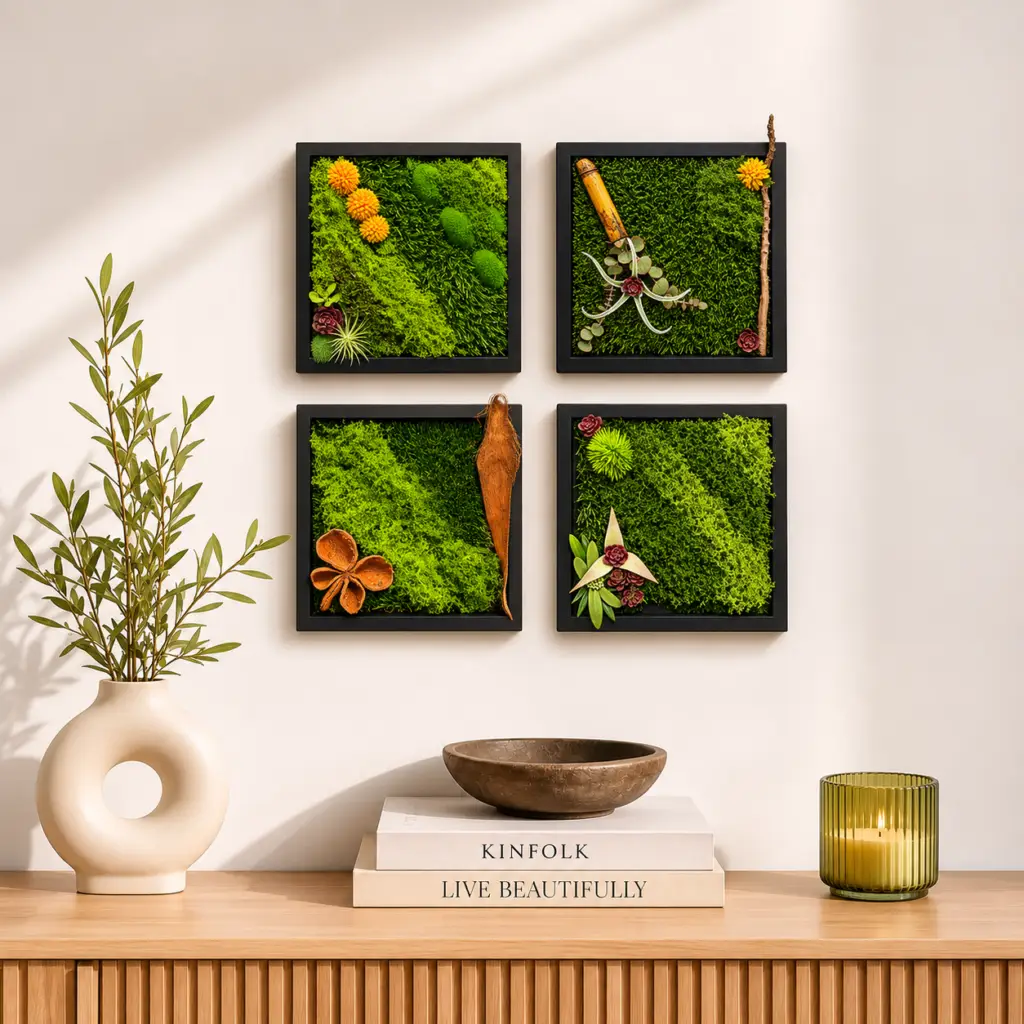
The frame material should complement the natural character of moss. Wood is the most common choice because it warms the look and blends with indoor plants, wooden furniture and neutral walls. A matte finish works better than a glossy one, because gloss can reflect light and distract from the moss texture. Black or dark wood frames give a contemporary contrast that makes green pop. Light wood or white frames feel airy and suit Scandinavian or minimalist interiors.
Metal frames are an option for industrial or modern spaces. They tend to be slimmer, so you need to check the depth carefully. A thin metal frame with a shallow back can struggle to hold thick moss without bowing. If you go for metal, look for a reinforced backing board and a depth that matches the moss layer.
Whatever material you choose, the frame must be rigid. Preserved moss is not heavy, but over time a flimsy frame can twist or separate at the corners, especially if the wall gets indirect sunlight and temperature changes. A solid corner joint - mitred and glued or fastened with brackets - is a sign of quality.
Glass or no glass
This is one of the most debated points in moss framing. Glass protects the moss from dust, curious fingers and the occasional splash. It also keeps the display sealed, which helps the preservative last longer. But glass can cause glare, and it creates a barrier between the viewer and the tactile surface of the moss.
For most indoor settings, a clear acrylic panel is a good compromise. Acrylic is lighter, less likely to break, and can be treated with an anti-glare coating. It still protects the moss while reducing reflections. If the moss piece is placed opposite a window or under a bright light, anti-glare acrylic is almost essential.
Going without glass gives the most natural look. The moss is fully exposed, and people can see the tiny leaves and stems up close. The trade-off is that dust settles on the moss over time, and you need to clean it gently with a soft brush or a hairdryer on a cool setting. If the piece is high up or in a low-traffic area, dust is less of a problem. In a busy room or near a kitchen, glass or acrylic is more practical.
Mounting hardware and hanging height
A frame that looks perfect on the floor can become a headache when you try to hang it. Preserved moss frames are often heavier than they look, because the backing board, the frame wood and the moss itself add up. The mounting hardware needs to be rated for the total weight, not just the frame size.
Most quality frames come with D-rings and wire or a sawtooth hanger. For a larger moss piece, D-rings with a braided wire are more reliable than a single sawtooth hanger. The wire should sit taut so the frame hangs level and stays stable. If the wall surface is plasterboard, use wall anchors or toggle bolts. A moss frame that falls can damage the moss and the floor.
Hanging height is another detail that affects the overall impression. A moss wall should be at eye level for the average person standing in the room. That usually means the centre of the piece is around 145 to 155 centimetres from the floor. In a hallway or a stairwell, you may need to adjust so the piece aligns with the sightline of someone walking past. Getting the height right makes the moss feel like part of the architecture rather than an afterthought.
Visual balance and room scale
A frame that is too small for the wall will look lost. A frame that is too large can dominate the space and crowd other elements. The rule of thumb is to consider the wall area and the furniture nearby. A moss piece above a sofa should be roughly two-thirds the width of the sofa. In a dining room, a square or rectangular frame centred on the wall creates a strong focal point. In a bedroom, a smaller piece above the bed can act as a calm accent.
Colour also plays a role in visual balance. The frame colour should echo something else in the room - the window frames, the table legs, the picture rail. That subtle repetition makes the moss feel intentional. If the room has mostly cool tones, a warm wood frame can introduce a natural contrast. If the room is already busy with patterns and textures, a simple black or white frame lets the moss do the talking.
Scale is not just about width and height. The frame's profile - how far it projects from the wall - affects how the piece sits in the room. A chunky frame in a small room can feel heavy. A thin frame in a large room can feel insubstantial. The best choice is the one that makes the moss look like it belongs there, not like something that was added on afterwards.

Practical checks before you buy
Before you settle on a frame, hold it against the wall where the moss will go. Look at it from different angles and in different light. Check that the frame colour does not clash with the wall or the floor. Make sure the depth is enough for the moss layer without the glass pressing on it. Test the hanging hardware by lifting the frame gently - if it feels unbalanced, choose a different mounting system.
If you are framing a custom moss piece, allow a few extra millimetres inside the frame for the moss to expand slightly with humidity changes. Preserved moss is stable, but it can shift a little in very damp or very dry conditions. A tight fit can cause buckling over time.
Ultimately, a good frame for preserved moss is one that protects the material, suits the room, and fades into the background so the moss can be the focus. When those three things line up, the result is a piece that feels natural, durable and quietly beautiful in any Home.